

The best prompt for a product description is not “write a description” but a short brief: role, product facts, audience, restrictions and response format. Give ChatGPT or Claude specs and clear rules, and you get a usable draft. Without facts, the model fills the gaps with plausible inventions. Below are seven templates for descriptions, titles and meta descriptions, each with who it suits and where it is weak. After them come a fact-check checklist and a process for bulk generation.
Key takeaways
- A good prompt includes a role, product data, audience, restrictions and an output format. A bare "write a description" gives you fluff and invented specs.
- A meta description is not a ranking factor, but it affects the snippet and click-through rate. Google may rewrite it, so write a unique, accurate one for every page.
- The model should take facts only from the data block and mark anything missing as "[clarify]". This is the main protection against hallucinations.
- Before publishing, check the text against specs, warranty, package contents and Product markup. Run bulk generation only after a pilot on 20–30 products.
Contents
- What a working prompt for a product description consists of
- 7 prompts for product descriptions: who they suit, why they work, what's wrong with them
- Product meta description: what it does and how to write it
- Fact-check checklist before publishing
- How to scale generation without falling under scaled content abuse
- ChatGPT or Claude for product descriptions: how to choose without arguments
What a working prompt for a product description consists of
OpenAI’s prompt engineering guide recommends clearly specifying the role, context, output format, length and tone constraints, and adding examples (few-shot). For a product page this turns into seven blocks. If any one is missing, quality drops right away.

| Block | What to include | Typical mistake |
|---|---|---|
| Role and goal | Who is writing, for which store, for which page | Not saying it is a product page rather than a blog post |
| Product data | Name, “parameter: value” attributes, package contents, warranty | Pasting only the name and expecting a “smart” result |
| Audience and USP | Who buys, what problem it solves, what makes it different | Asking to “highlight the benefits” without giving a single one |
| Keywords | One main query and 2–3 secondary ones | Asking to use a phrase “5–7 times”: the text becomes lifeless |
| Restrictions | Invented facts, “best”, calques from Russian, delivery promises | Not banning invention, so the model adds certificates and materials |
| Output format | HTML, length, number of paragraphs, spec list | Not setting a format and then stripping markup by hand |
| Example | 1–2 of your real descriptions as a tone sample | Giving an example from another category, so the model copies its structure |
Always separate data from instructions: use separate headings or delimiters such as ###. That way the model won’t mistake a spec for a command and finds it easier to follow the “facts only from here” rule.
7 prompts for product descriptions: who they suit, why they work, what’s wrong with them
The templates work in both ChatGPT and Claude. Fill in the variables in curly braces manually or from a spreadsheet. Test a prompt on 3–5 products from different categories first, and only then scale it.
1. Basic product page description
- Who it suits: stores with dozens or hundreds of items and a spec table.
- Why it works: the model is limited to the data block and has no room to invent.
- Drawback: the text comes out correct but flat. Without a USP and a tone example it looks like thousands of other product pages.
|
1 2 3 4 5 6 7 8 9 10 11 12 13 14 15 16 17 18 19 20 21 |
Ти — копірайтер інтернет-магазину {{категорія}} в Україні. Напиши опис картки товару українською. ### ДАНІ ТОВАРУ (єдине джерело фактів) Назва: {{назва}} Характеристики: {{параметр: значення; параметр: значення}} Комплектація: {{...}} Гарантія: {{...}} ### КОНТЕКСТ Аудиторія: {{хто купує і для чого}} Головна перевага (USP): {{...}} Ключові слова: {{основне; додаткове 1; додаткове 2}} — вживай природно, без повторів поруч. ### ПРАВИЛА - Використовуй лише факти з блоку даних. Якщо чогось бракує — пиши [уточнити], не вигадуй. - Без слів «найкращий», «унікальний», «революційний» і порожніх епітетів. - Без російських кальок, терміни — загальноприйняті українські. - 120–160 слів: 2 абзаци й список із 4–5 пунктів. ### ФОРМАТ HTML лише з тегами p і ul. |
The instruction “don’t invent, mark it [clarify]” is the most important line in the prompt. Without it, the model will happily add a material, certificate or warranty period that isn’t in your data.
2. “Feature → benefit” block
- Who it suits: appliances, electronics and tools, where buyers get lost in the specs.
- Why it works: it translates a dry parameter into the language of the buyer’s task without adding new facts.
- Drawback: the model may attribute a benefit the parameter doesn’t deliver. For example, it may take a battery capacity and conclude “a full day of work”. Such wording needs checking.
|
1 2 3 4 5 6 |
Перетвори характеристики на 5 коротких пунктів за схемою «характеристика — що це дає покупцеві». Користуйся лише даними нижче. Не вказуй цифр, яких немає в даних. Якщо вигода залежить від умов використання, напиши це прямо. Дані: {{параметр: значення; ...}} Аудиторія: {{...}} Формат: маркований список, до 15 слів на пункт. |
3. Title and meta description for a product page
- Who it suits: anyone whose meta descriptions are empty or filled in automatically from a template.
- Why it works: it gives several options at once, and you pick the most accurate.
- Drawback: the model counts characters poorly. Length has to be checked separately, and sometimes you need to ask for a shorter version.
|
1 2 3 4 5 6 |
Для товару нижче запропонуй 3 варіанти title і 3 варіанти мета-опису. Title: до 60 символів, ключова характеристика на початку, без капсу. Мета-опис: 140–155 символів, одне конкретне речення про товар і одна причина клікнути (наявність, гарантія, комплектація — лише якщо вони є в даних). Без вигаданих знижок і термінів доставки. Виведи таблицею: варіант, текст, кількість символів. Дані: {{назва; ключові атрибути; ключовий запит}} |
4. Description in the brand’s tone of voice
- Who it suits: brands with a recognizable style: playful, expert, gentle.
- Why it works: two or three of your real texts set the tone more precisely than any description in adjectives.
- Drawback: if the samples are weak, the model scales up their weaknesses. It may also copy phrases from the samples word for word.
|
1 2 3 4 5 6 7 8 9 10 |
Нижче два наших затверджених описи. Проаналізуй тон: довжину речень, звертання, лексику, гумор. Не копіюй фрази, лише стиль. ### ЗРАЗОК 1 {{текст}} ### ЗРАЗОК 2 {{текст}} Тепер напиши опис нового товару в тому самому стилі. Дані товару: {{...}} Обмеження: без вигаданих фактів, 100–140 слів, звертання на «ви». |
It’s convenient to store samples and rules once rather than paste them every time. Claude has Projects for this: instructions and tone examples live in the project, and in the chat you add only the product data.
5. Description for Google Merchant Center and marketplaces
- Who it suits: stores with a product feed for Google, as well as sellers on Rozetka or Prom.ua.
- Why it works: Merchant Center requires an accurate description without promotional calls to action, links or extra formatting, and that requirement is easy to build into a prompt.
- Drawback: each marketplace’s rules differ and change. The prompt doesn’t know them, so check current requirements in the seller account.
Merchant Center advises putting the most important attributes at the start of the title and avoiding promotional text and all caps. Title length is up to 150 characters, description up to 5,000. Details are in the Merchant Center help page on the description attribute.
|
1 2 3 4 5 |
Підготуй title і description для фіду товарів. Title: до 150 символів, спочатку тип товару й ключові характеристики, потім бренд і модель. Без капсу, рекламних слів і емодзі. Description: звичайний текст без HTML, посилань, закликів «купуйте» і згадок цін чи акцій. Лише факти з даних, 400–900 символів. Дані: {{атрибути}} |
6. Product variants: size, color, package contents
- Who it suits: clothing, footwear and accessory stores where one product has dozens of variants.
- Why it works: it generates one shared description and a short block of differences instead of ten rewritten copies.
- Drawback: if the variants barely differ, separate unique texts make no sense. For such pages Google recommends canonicalization (
rel=canonical), which is simpler and more honest.
|
1 2 3 4 5 6 |
Є товар із варіантами. Напиши: 1) один спільний опис (80–120 слів) для основної сторінки; 2) для кожного варіанта — 1–2 речення лише про те, чим він відрізняється (розмір, колір, комплектація), без повторення спільного опису. Факти — тільки з таблиці нижче. Якщо різниці в даних немає — так і напиши. Таблиця варіантів: {{...}} |
7. Bulk generation from a spreadsheet or via API
- Who it suits: catalogs of a few hundred items or more with a clean attribute table.
- Why it works: the JSON response goes straight into import, and the
missing_datafield shows where data was lacking. - Drawback: you need a script or a developer, and quality control becomes a separate process. Without it, you risk publishing thousands of identical, weak texts.
|
1 2 3 4 5 |
Ти генеруєш контент для картки товару. Поверни лише валідний JSON без пояснень. Поля: {"description_html": "...", "meta_title": "...", "meta_description": "...", "missing_data": ["..."], "risk_flags": ["..."]} Правила: факти лише з рядка даних; відсутнє — у missing_data; будь-яке твердження про сертифікати, матеріали чи гарантію без даних — у risk_flags. Рядок даних: {{JSON або CSV-рядок товару}} |
To learn how to connect the model to WordPress and WooCommerce, read the article on integrating the Claude API with WordPress. A separate look at ChatGPT is in the article on writing a product page description with ChatGPT.
Product meta description: what it does and how to write it
According to Google’s documentation, the meta description is not a ranking factor. It may be used for the search snippet, but Google often builds the snippet itself from the page content. So a meta description is there for clicks (CTR), not for moving up in rankings. This matters because many people expect “SEO magic” from it and then end up disappointed.
Google advises making meta descriptions unique for each page and giving a short, accurate summary rather than repeated boilerplate phrases. For a store this means that a line like “Buy {{name}} in Kyiv at a great price” on every page is a weak option. Read the official snippet guidelines: they show clearly what the search engine expects.
What to put in a product meta description:
- one or two key specs people search by (capacity, power, material, size);
- what sets the offer apart: package contents, warranty, availability. Only if it is true and current;
- the main query in a natural form, without a list of keywords.
Length is a guideline, not a rule. Search often shows about 150–160 characters in full, but depending on the device Google may cut the text earlier or show a different fragment altogether. So put the most important part first.
Ask the model to write the meta description not from the product name but from the finished description and the attribute list. Then it matches the visible page text, and there is no mismatch between the snippet and the product page.
Fact-check checklist before publishing
AI writes confidently even when it is wrong. For a product page this is especially dangerous: an invented material, power rating or warranty turns into customer complaints and a risk under consumer protection law. Google doesn’t ban AI content as such, but it advises against passing off unverified generated text as verified. For product pages it separately stresses accurate metadata. Go through this checklist before publishing.
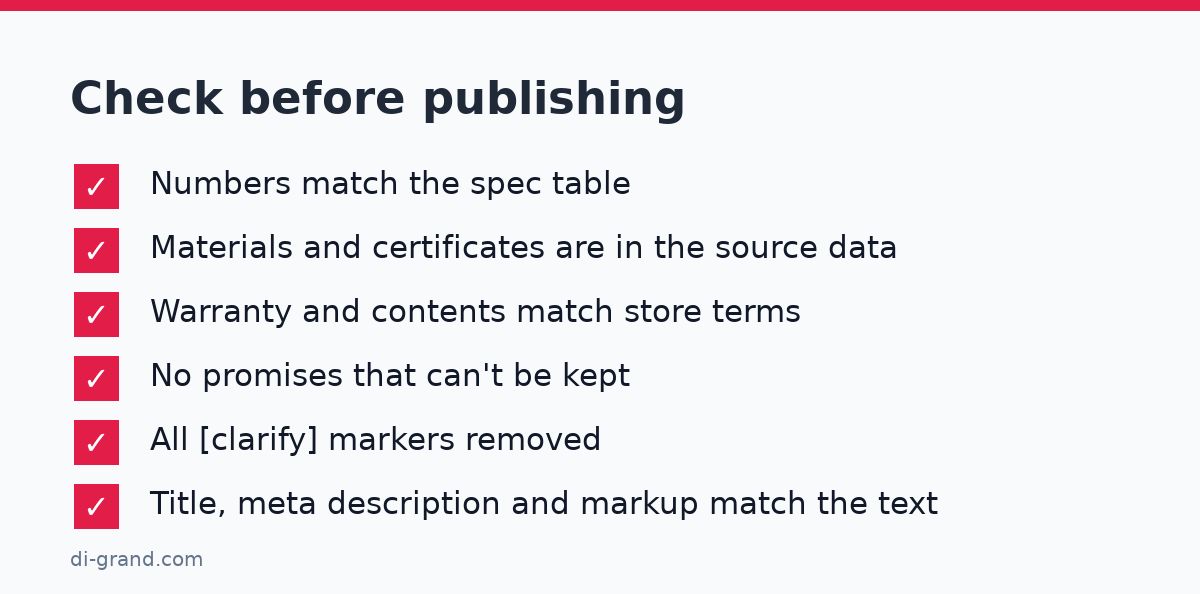
- Every number, size, volume and power rating in the text matches the spec table or the manufacturer’s data.
- Materials, country of origin, certificates and standards are in the source data and did not appear “from the model”.
- Warranty, package contents and return terms match the store’s real terms.
- There are no promises you can’t keep: “delivery tomorrow”, “best price”, “original” without confirmation.
- The text makes no claims about medicinal, safety or environmental properties without documents.
- The
[уточнити]markers have been removed and the gaps filled with real data. - There are no calques from Russian, no terminology errors and no confusion in units of measure (mm, cm, l, kg).
- Title, meta description and Product markup (name, description, offers) are consistent with the visible page content.
- The text doesn’t repeat the manufacturer’s description or neighboring product pages word for word.
A separate note on markup: in Product structured data, the values must match what the user sees on the page. If the AI description changed the specs while the markup kept the old ones, that is a mismatch. More in Google’s spam policies, which also describe “scaled content abuse”.
The checklist doesn’t replace a legal review. If you sell regulated goods (children’s products, food, medical items, cosmetics), agree the wording with a lawyer.
How to scale generation without falling under scaled content abuse
Google prohibits not AI texts but the mass creation of low-value pages to manipulate rankings. It doesn’t matter who makes them: a person or automation. So the question is not “can we generate” but “is every product page genuinely useful to the buyer”. Here is a safe order of work.
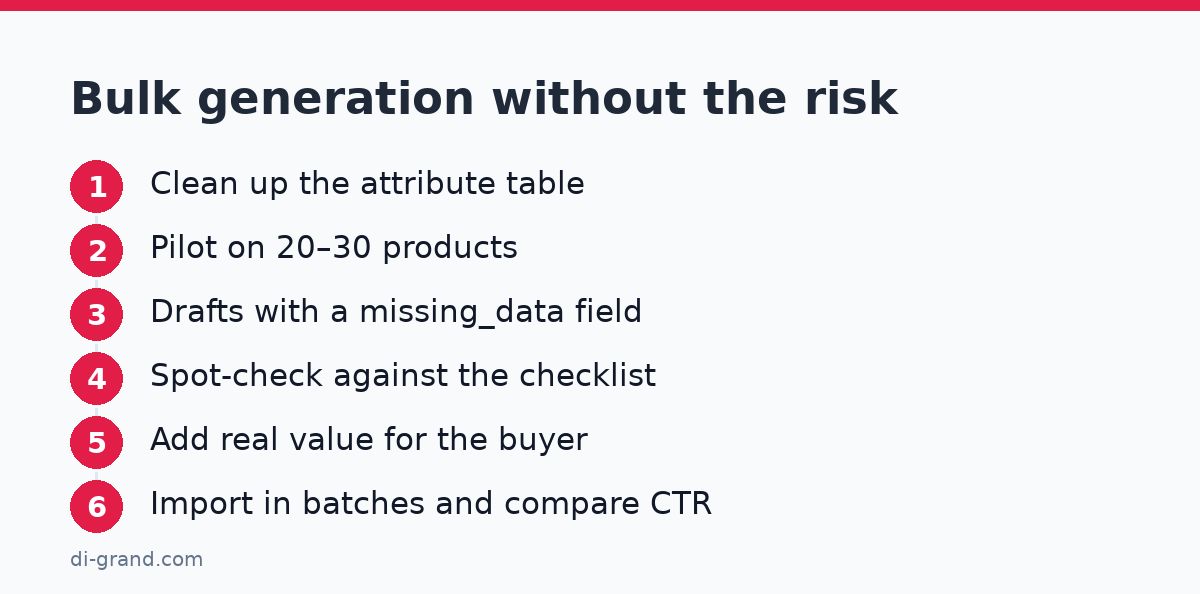
- Clean up the spreadsheet. One product, one row, identical column names, units of measure in one format. The model won’t fix a mess in the data, it will just repeat it nicely.
- Run a pilot on 20–30 products. Choose different categories to see the weak spots of the prompt.
- Generate drafts with a missing_data field. Set aside products with gaps in the data rather than “filling them in” blindly.
- Go through the checklist. Check selectively, but at least every tenth page and all those flagged in
risk_flags. - Add human value. For top products, add real tips, usage nuances and answers to buyer questions.
- Import in batches and compare. Track CTR, page metrics and conversion. It’s worth leaving some pages with their old descriptions as a control group for comparison.
It’s handy to display attributes from the table on the page itself. How to do that is described in the article on product attributes in WooCommerce below the short description. Then the structured data and the text read as one whole.
ChatGPT or Claude for product descriptions: how to choose without arguments
There is no universal answer: the result depends on the category, the quality of your data and how carefully the prompt is written. Both models handle Ukrainian, but style, tendency toward fluff and adherence to restrictions vary from product to product. So compare them on your own catalog, not on other people’s reviews.
| Criterion | How to check |
|---|---|
| Following the “facts only from the data” rule | Give incomplete data and see whether the model inserts [clarify] or invents |
| Quality of Ukrainian | Read 10 texts aloud: calques, artificial phrasing, terminology errors |
| Reproducing tone of voice | Compare the result with the samples to see whether it copies phrases word for word |
| Format stability | Run one prompt on 20 products and see how many responses needed fixing |
| Cost and limits | Calculate the price for your catalog size using current rates on the services’ websites |
For a broader comparison for business, read Claude or ChatGPT: which is better for business in Ukraine. If the pilot results are close, choose by convenience: where it is easier to store instructions, connect the API and set up checks.
Where to start today: take five of your products, plug them into prompt #1 and run the text through the checklist. Then add prompt #3 for meta descriptions and compare the result with your old texts. If you want to automate the process in WooCommerce, with generation, checking and import, the DiGrand team can help design it for your catalog. Leave a request for a consultation on implementing AI in an online store.
FAQ
Which prompt works best for a product description in an online store?
The best one contains a role, a block of product facts, the audience, restrictions and an output format. The main rule: the model uses only the data you provide and marks anything missing as "[clarify]". Start with basic template #1 from this article and add examples of your tone of voice.
Does Google penalize product descriptions written by ChatGPT or Claude?
Google doesn't ban AI content as such. It fights the mass creation of low-value pages to manipulate rankings, regardless of who creates them. If you check the facts and add real value for the buyer, the risk is much lower.
Does the meta description affect the ranking of a product page?
According to Google's documentation, the meta description is not a ranking factor. It may end up in the snippet and affect click-through rate, but Google often builds the snippet itself from the page content. So write it unique and accurate for each product page.
How can I reduce the risk of invented specs (hallucinations) in AI descriptions?
Give the model structured data, forbid invention and ask it to flag gaps. Separately, require a field such as risk_flags for claims without a source. After generation, always check numbers, materials, warranty and package contents against the checklist.
Do I need to label product descriptions as AI-generated?
Google advises disclosing the use of generative AI where appropriate and not passing off unverified text as verified. For product pages, what matters most is accuracy and responsibility for what is written. Whether to add a label is up to your store's policy and the platform's requirements.
Can I use these prompts for Rozetka, Prom.ua and Google Merchant Center?
Yes, as a basis: change the output format and length. For Merchant Center, the description must have no promotional calls to action or links, the title is up to 150 characters and the description up to 5,000. Check marketplace requirements in the seller account, as they may change.
Leave a Reply